

Battery Storage & Solar Batteries – AGM, LFP & Powerstations


2 Meter (€22.21 / 1 Meter)
Content: 2 Meter (€22.21 / 1 Meter)
Shipped in 1-3 Days (Mo-Fri)
Shipped in 1-3 Days (Mo-Fri)

Shipped in 2-5 Days (Mo-Fri)
Shipped in 2-5 Days (Mo-Fri)

Shipped in 1-3 Days (Mo-Fri)
Shipped in 1-3 Days (Mo-Fri)

Shipped in 1-3 Days (Mo-Fri)
Shipped in 1-3 Days (Mo-Fri)

0.2 Meter (€19.95 / 1 Meter)
Content: 0.2 Meter (€19.95 / 1 Meter)
Shipped in 1-3 Days (Mo-Fri)
Shipped in 1-3 Days (Mo-Fri)

Shipped in 1-3 Days (Mo-Fri)
Shipped in 1-3 Days (Mo-Fri)

Product is expected to be back in stock on 29 January 2027
Product is expected to be back in stock on 29 January 2027

Shipped in 2-5 Days (Mo-Fri)
Shipped in 2-5 Days (Mo-Fri)

Shipped in 1-3 Days (Mo-Fri)
Shipped in 1-3 Days (Mo-Fri)

Shipped in 2-5 Days (Mo-Fri)
Shipped in 2-5 Days (Mo-Fri)

Shipped in 2-5 Days (Mo-Fri)
Shipped in 2-5 Days (Mo-Fri)

Shipped in 1-3 Days (Mo-Fri)
Shipped in 1-3 Days (Mo-Fri)

Shipped in 1-3 Days (Mo-Fri)
Shipped in 1-3 Days (Mo-Fri)

Shipped in 1-3 Days (Mo-Fri)
Shipped in 1-3 Days (Mo-Fri)

Shipped in 1-3 Days (Mo-Fri)
Shipped in 1-3 Days (Mo-Fri)
Shipped in 1-3 Days (Mo-Fri)
Shipped in 1-3 Days (Mo-Fri)

Shipped in 1-3 Days (Mo-Fri)
Shipped in 1-3 Days (Mo-Fri)

Shipped in 1-3 Days (Mo-Fri)
Shipped in 1-3 Days (Mo-Fri)

Shipped in 2-5 Days (Mo-Fri)
Shipped in 2-5 Days (Mo-Fri)

Shipped in 1-3 Days (Mo-Fri)
Shipped in 1-3 Days (Mo-Fri)

Shipped in 1-3 Days (Mo-Fri)
Shipped in 1-3 Days (Mo-Fri)

Shipped in 1-3 Days (Mo-Fri)
Shipped in 1-3 Days (Mo-Fri)
Shipped in 2-5 Days (Mo-Fri)
Shipped in 2-5 Days (Mo-Fri)

1.5 Meter (€44.96 / 1 Meter)
Content: 1.5 Meter (€44.96 / 1 Meter)
Shipped in 1-3 Days (Mo-Fri)
Shipped in 1-3 Days (Mo-Fri)

Everything You Need to Know About Batteries and Energy Storage
With the right solar battery, you can use the electricity you generate yourself exactly when you need it. Whether in a RV, on a boat, in a garden shed, at home as a balcony power plant, or in a commercial setting: At Offgridtec, you’ll find storage solutions for self-sufficient power supply, photovoltaic systems, mobile applications, and reliable backup systems.
This category provides an overview of various battery technologies and storage types. The subcategories take you directly to suitable solutions such as lithium batteries, AGM batteries, gel batteries, power stations, PV storage systems, commercial storage systems, starter batteries, and battery accessories.
Which energy storage solution is right for your application?
Not every battery is ideal for every purpose. Key factors include capacity, voltage, weight, depth of discharge, charging behavior, cycle life, and the intended location of use. For mobile applications, weight and a compact design are often key considerations, while for stationary PV systems, self-consumption, storage capacity, and system integration take center stage. In the commercial sector, cost-effectiveness, peak loads, and potential incentives also come into play.
- Commercial Storage:
For businesses, agriculture, industrial facilities, and larger PV projects. A commercial PV storage system can help increase self-consumption, reduce peak loads, and make energy costs more predictable. - Lithium Batteries:
Modern LFP and lithium storage systems offering high cycle life, low weight, and high performance. Particularly popular as lithium batteries for RVs, boats, camping, and off-grid solar systems. - Power Stations:
Portable storage solutions for camping, outdoor activities, emergency power, gardening, and mobile devices. Ideal if you want to take power with you flexibly without installing a permanent battery system. - PV Storage:
Photovoltaic storage systems for homes, self-consumption, and backup applications. They store solar power from your PV system and make it available later. - Starter Batteries:
Batteries for vehicles where a reliable starting process and a stable onboard power supply are key. - AGM Batteries:
Low-maintenance, robust, and leak-proof batteries for solar, recreational, boating, RV, and many power supply applications. - Gel batteries:
Cycle-resistant, sealed batteries for consistent power delivery, longer service life, and applications requiring high operational reliability. - Accessories:
Battery accessories such as chargers, battery monitors, battery monitoring systems, cables, connectors, fuses, and components for safe installation.
Solar Batteries for RVs, Boats, and Off-Grid Systems
Solar batteries are particularly useful for RVs, campers, boats, or garden sheds if you want to power lights, coolers, water pumps, chargers, or other appliances independently of the power grid. Lithium batteries stand out for their low weight, high usable capacity, and long service life. AGM and gel batteries are a proven alternative if you’re looking for a robust, low-maintenance, and leak-proof solution.
Especially for mobile systems, you should ensure you have the correct voltage, sufficient capacity, and a suitable charger. A 12V lithium battery or a 100Ah AGM battery may be sufficient for many smaller systems, while larger loads require more capacity or a more powerful overall system.
PV Storage and Commercial Storage for Greater Self-Consumption
A PV storage system helps you make better use of the solar power generated by your photovoltaic system. Instead of feeding excess energy directly into the grid, it is temporarily stored and consumed later. This is particularly beneficial for households that want to increase their self-consumption and become less dependent on the power grid.
If you want to expand an existing system, a retrofit PV storage system is often a sensible option. Whether a storage system is technically and economically feasible depends on your PV system, your electricity consumption, the inverter, the desired backup function, and the installation conditions.
For businesses, agricultural applications, and larger buildings, commercial storage systems are an option. In addition to storage capacity, load profiles, consumption peaks, grid connection, commercial storage costs, potential subsidies, and proper sizing all play an important role here. Systems in the range of approximately 100 kWh or more should be planned on a case-by-case basis.
Retrofitting Storage for Your Balcony Power Plant
If you want to add storage to your balcony solar system, compact lithium-ion battery storage units or storage solutions specifically designed for balcony solar systems are suitable options. Key factors include the appropriate capacity, compatibility with your solar panels and inverter, as well as connections, charging power, and depth of discharge. You can find ready-to-install complete balcony power plant systems that include storage in our balcony power plant section, and suitable storage solutions for retrofitting in our PV storage section.
Power Stations as a Mobile Alternative
Power stations are compact energy storage devices with built-in connections. They’re ideal for camping, outdoor activities, events, powering tools, coolers, laptops, or as a flexible emergency power solution. When comparing portable power stations, consider not only capacity but also output power, charging speed, solar charging capability, weight, and connection options.
Tests and comparisons can help you make an informed decision. Ultimately, though, the key factors are which devices you actually want to power and how long the power station needs to supply energy.
AGM, Gel, or Lithium: The Key Differences
Lithium batteries are particularly efficient, lightweight, and have excellent cycle life. They are well-suited for modern solar systems, RVs, and applications that require a high usable capacity with the lowest possible weight.
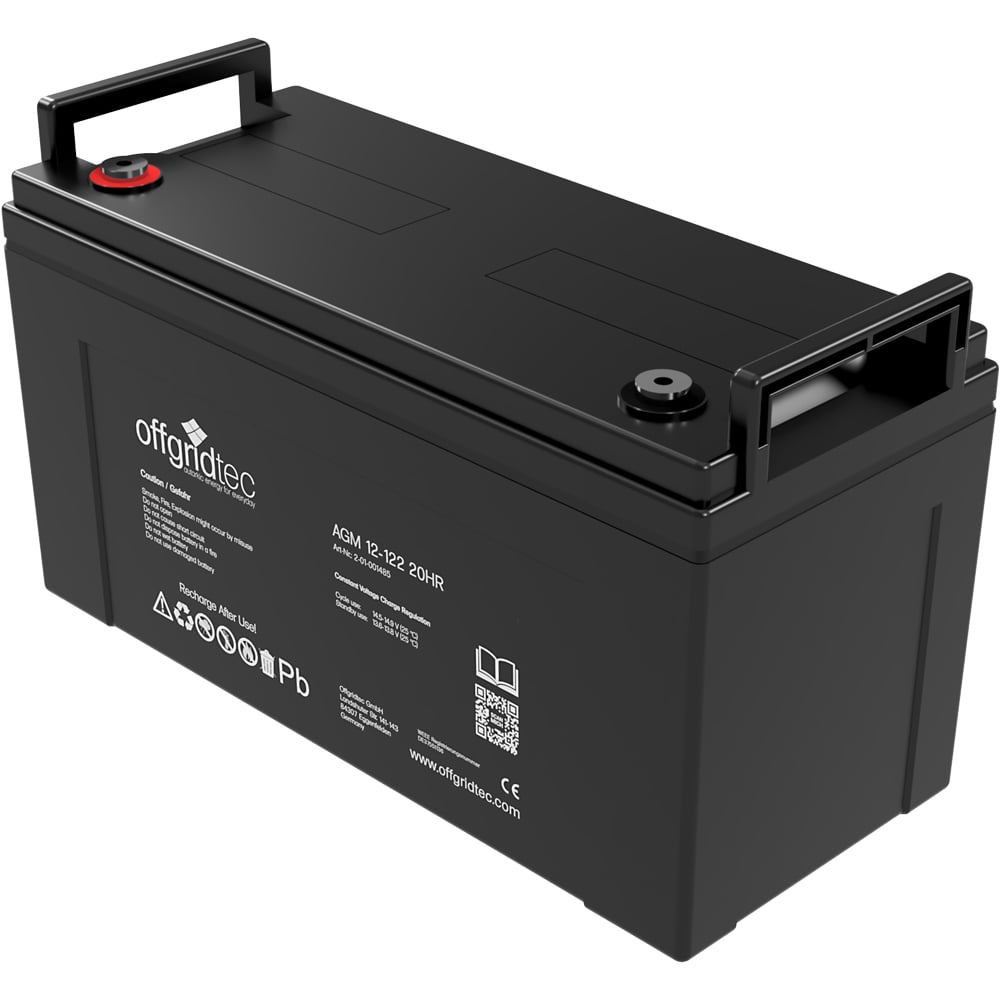
AGM batteries are sealed lead-acid batteries in which the electrolyte is bound within fiberglass mats. They are low-maintenance, robust, and versatile. Gel batteries use a gel-like electrolyte and are well-suited for applications requiring a steady discharge rate and high operational reliability.
Which technology is right depends on your project. For mobile solar systems, lithium may be the best choice. For simple, rugged, and cost-conscious applications, AGM or gel batteries may be a very good fit.
Battery Accessories for Safety and Control
A reliable battery system consists of more than just the battery itself. The right battery accessories ensure that your system operates safely, cleanly, and under control. These include chargers, battery cables, fuses, terminal clamps, connectors, battery monitors, and battery monitoring solutions.
Battery monitoring is particularly useful if you want to keep track of the state of charge, voltage, or power consumption. This applies to solar systems as well as RVs, boats, and vehicles.
Buy Solar Batteries and Storage Systems at Offgridtec
At Offgridtec, you’ll find a wide selection of batteries, storage systems, and accessories for solar, camping, home, commercial, and off-grid energy applications. Use this category as a starting point, then select the subcategory that best fits your project.
If you’re unsure which battery is right for your system, our experts will help you make the right choice. This way, you’ll find a storage solution that’s technically compatible with your system, your energy consumption, and your intended use.
FAQs on Solar Batteries, Energy Storage Systems, and Battery Accessories
- Which solar battery is right for my project?
That depends on your application. Lithium batteries are often particularly practical for RVs, boats, and mobile solar systems. For rugged power supply applications, AGM or gel batteries can be a good choice. For residential and commercial use, PV storage systems or commercial storage systems are recommended. - What is the difference between a solar battery, a rechargeable battery, and a PV storage system?
All these terms describe energy storage devices. “Solar battery” is the general term; “rechargeable battery” refers to the rechargeable function; and “PV storage” usually means a storage system for a photovoltaic system. - When is a commercial storage system worthwhile?
A commercial storage system is particularly worthwhile if a business wants to use a lot of its own solar power, reduce peak loads, or make its energy supply more predictable. The cost-effectiveness depends on consumption, load profile, storage capacity, costs, and potential incentives. - Can I retrofit a PV storage system?
Yes, many existing photovoltaic systems can be expanded with a storage system. Key factors include technical compatibility, the existing inverter, the desired range of functions, and professional installation. - Does a lithium battery make sense for a motorhome?
Yes, a lithium battery for a motorhome is often a good idea if you want to save weight, get more usable capacity, and take advantage of many charge cycles. 12V lithium batteries, in particular, are a great option for many camper systems. - What does AGM battery mean?
AGM stands for Absorbent Glass Mat. In this type of battery, the electrolyte is bound within glass fiber mats. AGM batteries are low-maintenance, leak-proof, and suitable for many solar, recreational, and power supply applications. - How do I properly charge AGM or gel batteries?
AGM batteries and gel batteries should be charged using a compatible charger or solar charge controller. It’s important that the charging profile, voltage, and charging curve are appropriate for the specific battery technology. - What are power stations good for?
Power stations are ideal for mobile power supply while camping, in the garden, on the go, at events, or as a flexible emergency power solution. They’re especially convenient if you’re looking for a portable solution with built-in connections. - What battery accessories are useful?
Depending on your setup, useful accessories include battery cables, fuses, chargers, terminal clamps, battery monitors, and battery monitoring components. These allow you to connect your system safely and better monitor the condition of your battery. - How do I properly dispose of a lithium battery?
Lithium batteries do not belong in household trash. Dispose of them at appropriate collection points, recycling centers, or retail take-back locations. Damaged batteries should be handled with special care and disposed of separately. - Is a balcony power plant with storage worth it?
A balcony solar power system with storage can be worthwhile if you generate more solar power during the day than you consume directly. The storage system helps you use excess energy later, for example in the evening or when there is little sunlight.